From a humble convent school in 1907 to a global university, the story of St. Paul University Philippines is a testament to resilience, innovation, and unwavering service.
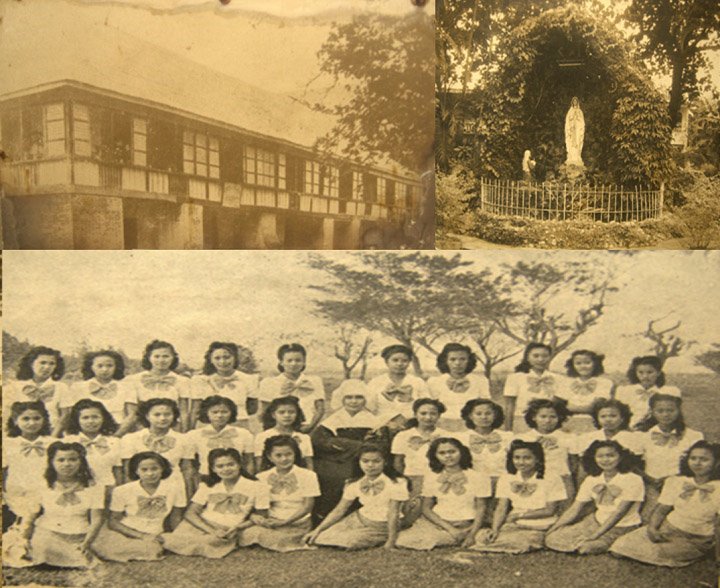
It began with an invitation. On May 10, 1907, the Sisters of St. Paul of Chartres arrived in the Cagayan Valley, responding to the call of Bishop Dennis Dougherty. Led by Mother Ephrem Marie Fieu, the pioneer sisters—including Sr. Suzanne du Sacre Coeur Cran, Sr. Agnes de Sainte Anne Couplan, Sr. Jeanne de St. Louis Bourrelly, Sr. Marie Angeline Acau, and Postulant Sr. Ste. Foy de Sacre Coeur Sacramento—established Colegio de San Pablo.
The school initially occupied a Spanish Convento adjoining the Cathedral. It was a modest beginning, but the mission was clear: to provide Catholic education to the youth of the region. As enrollment grew, so did the institution's identity. In 1909, the name was changed to Colegio del Sagrado Corazon de Jesus, and later to Sacred Heart of Jesus Institution (SHOJI) in 1925.
1934-1945 — Expansion & Conflict
Trials of Fire and War
The pioneer Sisters of St. Paul of Chartres laid the foundation for Catholic education in the region.
The need for curricular expansion led the community to move to the grounds of Colegio de San Jacinto in 1934—the very site where the University stands today—acquired from the Dominican Order. However, the clouds of war soon gathered. In 1941, the school was seized by Japanese forces, serving as a military garrison and hospital. Education was halted, but the spirit of the community remained unbroken.
The Liberation of 1945 brought with it a devastating blow: the entire school complex was razed to the ground. Yet, from the ashes of destruction, the seeds of renewal were sown.
"The physical structures were reduced to ash, but the foundation—built on faith and service—remained unshaken."
1948-1965 — Reconstruction
A Phoenix Rising
Reconstruction began in earnest. In 1948, the school assumed the name St. Paul College of Tuguegarao (SPCT) and distinguished itself as the first Teacher-Training Institution in the Cagayan Valley. This era marked a pursuit of academic excellence that would become the institution's hallmark.
By 1961, SPCT became the first accredited institution in the region by the Philippine Accrediting Association of Schools, Colleges and Universities (PAASCU). But history has a way of testing resolve. On January 18, 1965, tragedy struck once more as the entire complex was reduced to ashes by fire. Once again, the Paulinian community faced the challenge of rebuilding, proving that their spirit was fireproof.
1982 — The Milestone
The First University
Decades of perseverance culminated in a historic achievement. In 1982, St. Paul College of Tuguegarao was granted University status, becoming St. Paul University Philippines (SPUP). It stands as the first University and the first Catholic University in the Cagayan Valley region, a beacon of higher learning and faith formation.
2000s — Present
Global Recognition & Innovation
In the new millennium, SPUP expanded its horizons beyond the archipelago. It gained distinction as the First Private Catholic University in Asia to be granted ISO 9001 Certification by TUV Rheinland in 2000. Today, it is one of the few universities in the Philippines accredited by the Asian Association of Schools of Business International (AASBI) and serves as a World Bank Knowledge for Development Center (KDC).
Beyond its academic strides, SPUP has been a guardian of faith and history. In 2012, the Catholic Bishops’ Conference of the Philippines (CBCP) declared the university a Catholic Center for Culture, honoring its role in conserving the Church's patrimony. This commitment to heritage was further cemented in 2014 when the National Historical Commission of the Philippines (NHCP) bestowed a Historical Marker upon the institution, recognizing its pivotal role in the development of Cagayan Valley.
SPUP is recognized globally for its innovative programs and ethical values.
The university's commitment to innovation and ethics has been recognized on the world stage. SPUP was ranked 38th globally for Ethical Value by the World’s Universities with Real Impact (WURI) and listed among the Top 101-200 Innovative Universities in the world in 2021. Additionally, it was awarded the Third Prize in the First Philippine Higher Education Internationalization Award by CHED, cementing its status as a leader in cross-border education. Its internationalization efforts, including the ASEAN International Mobility for Students (AIMS) programme, have fostered a vibrant community of international scholars and cultural exchange.
Stewardship
Service to Humanity and Creation
True to its Paulinian mission, SPUP champions sustainable development and social responsibility. Recognized as a UNESCO Associated Schools Project Network (ASPNet) affiliate, the university was conferred the title of "Most Environment-Friendly and Sustainable School" in Region II. Its Community Development Center was awarded as the Best Non-Government Organization in Luzon by the DSWD in 2019.
In 2020, SPUP received the prestigious Prince Talal International Prize for Human Development for its contributions to the Sustainable Development Goal on Zero Hunger. Through education, service, and faith, St. Paul University Philippines continues to shape leaders who make a difference—locally, nationally, and globally.
“
The bottom line of success is not gauged by external rewards but felt as an inner fulfillment, and eventually in the scheme of things it is a life of integrity and service that will have a lasting legacy on humanity.